A concept worth dusting off
Back in the early 2010s, a handful of marketing blogs started talking about the T‑shaped profile. The idea was simple enough: you want someone with broad knowledge across a lot of disciplines (enough to collaborate with specialists and see how everything connects), combined with real depth in one specific area where they can actually deliver value. HubSpot wrote about it, McKinsey consultants picked it up, and growth teams built hiring frameworks around it. It caught on because it was honest about what modern cross‑functional work really requires: pure specialists tend to struggle the moment they have to collaborate, and pure generalists rarely deliver anything memorable.
Fifteen years later, the idea still holds up. And it applies remarkably well to one of the most underrated roles in radio right now, which is the Head of Digital.
A quick sidebar on the shape itself. Since the T‑model first appeared, it’s been extended in various ways. A V describes someone with two strong verticals, usually a more senior profile who’s had time to grow a second area of depth. A comb refers to three or more verticals with the broad horizontal across the top, which tends to describe experienced operators who’ve run teams across multiple disciplines for many years. If you’re already a V or a comb, you can skip the rest of this piece. For most Heads of Digital in radio, the T is where you start.
Why the Head of Digital role is harder than it looks
Let me say this upfront, because I know how it sounds: the Head of Digital at a radio station is one of the most complex digital jobs out there. I’m not trying to flatter anyone. I’ve watched people come into this role from radio, digital‑native media, or even tech companies, and almost all of them underestimate the complexity before they arrive.
In a tech company or a digital‑first media brand, the environment works with you. The product is digital by design, the culture is built around metrics and iteration, and everyone pulls roughly in the same direction. The person, whatever their title is called internally, can pick a slice of the value chain and go deep on it.
At a radio station, the situation is different. You’re running a digital layer on top of a broadcast medium that has its own gravity. Decades of editorial habits, producer instincts, and processes built long before podcasts existed. Sometimes broadcast and digital pull in the same direction. Often they don’t.
And while you’re navigating that, you’re also managing your own app, website, social media channels, Spotify, Apple Podcasts, YouTube, Amazon Music, smart speakers, etc. Every one of those has its own logic, its own algorithm, and its own way of telling you whether you’re winning or losing.
The KPIs don’t translate either. Broadcast audience is mostly declarative and remains a vague estimation released every quarter at best, while you are looking at why listeners drop off at minute 6 of a given show or why your app’s weekly active users have been flat for six months.
Then there are the internal politics. You have to convince a producer with twenty years of craft that the thumbnail matters or that the episode title affects discoverability. That a 50% ad render rate is a real problem, not a technical detail that someone should look at next quarter.
Mastering the full digital value chain in radio is genuinely complex. The T‑shape isn’t a nice‑to‑have framework here. It’s close to the minimum you need to survive in the role.
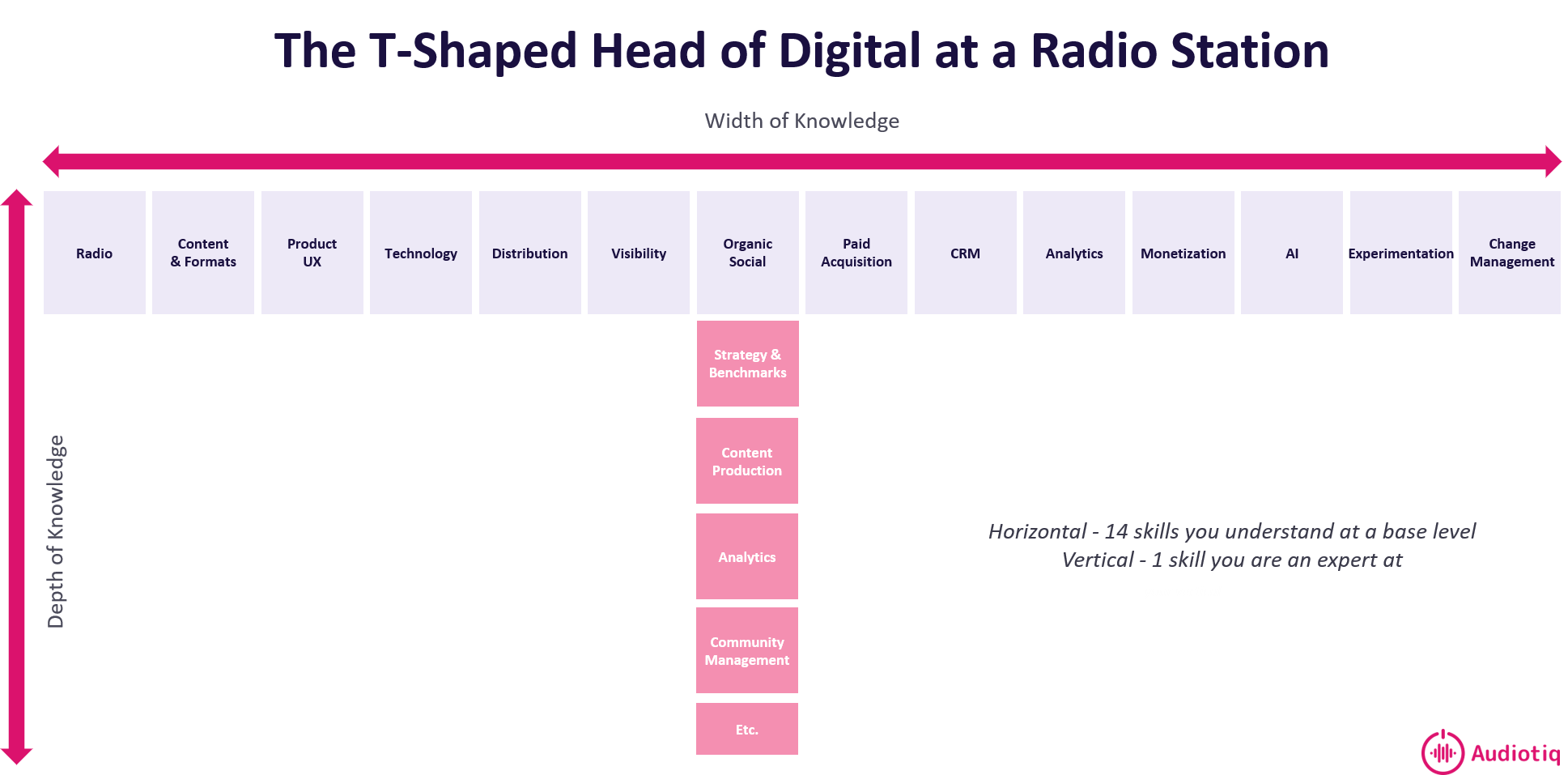
The horizontal bar: 14 skills to cover
Not every skill needs the same depth, which is why I find it useful to split them into three levels.
- Base means you understand the concept, can have an informed conversation about it, and can spot when something is going wrong. You’re not running the show in that area, but you’re not lost either.
- Foundation means you can operate autonomously, contribute meaningfully, evaluate work, and manage a specialist. You’ve actually done the thing, not just read about it.
- Expert is your vertical. This is where you set the standard, lead the thinking, and create real competitive advantage for the station.
Most Heads of Digital should be at base across the full horizontal, foundation in most of it, and an expert in one specific area. Here’s the list.
Radio / Broadcast.
This one is non‑negotiable, and it’s the one most “digital” candidates coming into radio are missing. Understanding how radio works isn’t about paying respect to the medium, it’s about credibility and understanding the environment you operate in. If you can’t hold a conversation about what makes a morning show work or audience measurement, you’ll miss the credibility needed to operate in your job. You don’t need to have been a program director, but you do need to have a good understanding of how radio works.
Content strategy & formats.
You’re not writing the scripts or producing the shows. But you do need to understand why a 45‑minute podcast episode works as audio and dies on YouTube, why a weekly cadence creates completely different listener behavior than a daily one, and why a short vertical video series might be the right call for a certain demographic where a podcast wouldn’t be. The same three questions apply to basically every format decision: does it stop the scroll, does it hold attention, does it leave people satisfied?
Product / UX.
Most radio digital products underperform for product reasons, not content reasons. The onboarding experience, where users drop off, whether activation flows exist at all, and whether the navigation is built for habitual listeners or new ones. You don’t have to be a product manager, but you need to think like one. Otherwise, you’ll keep shipping features that nobody uses and wondering why the metrics aren’t moving.
Technology.
I’m not talking about being able to write code, I’m talking about understanding architecture. You should know roughly what a data pipeline is and why it matters, what a CMS actually does, and how a badly configured ad server can quietly cut your revenue in half without anyone in the building noticing for months. Without that baseline literacy, two things happen. The technical team starts talking around you, and you lose the ability to tell when something is genuinely complex versus just described as complex to avoid doing it.
Distribution.
Getting your content onto the right platforms in the right format covers a lot of operational ground: RSS configuration, podcast directory submissions, app publishing, smart‑speaker skills. But it’s also strategic. Which platforms do you prioritize, and which do you deprioritize? When do you put a show as exclusive on your own app first to build a direct relationship with your audience? These are decisions with serious downstream effects on audience and revenue, and they are often underestimated.
Visibility optimization (ASO, SEO, PVO).
If done wrong, it’s probably the area where radio is missing out most on audience growth. With digital channels, discoverability is never automatic. A 40% lift in click‑through on a podcast listing often has nothing to do with better content and everything to do with a sharper title and a better cover image. Your app exists in the store, your podcast exists on Spotify, your articles exist on Google, but unless somebody is actively working on whether they actually surface to the right people, they might as well not.
Organic social.
The default mistake in radio is treating social like a megaphone for the broadcast. Clips posted, promos scheduled, engagement low, everyone wondering why. Organic social has become a content format with its own grammar and audience expectations, and it doesn’t necessarily convert to listening that can be monetized. The better question to ask isn’t how to grow followers, it’s how it’s actually moving anyone closer to your real content.
Paid acquisition.
Organic growth has a ceiling, and at some point, you have to pay to grow faster, like for the launch of a new web radio, for example. The trap I see constantly is stations running paid campaigns and judging them on click‑through rate. That’s the wrong measurement entirely. What matters is whether the listeners you paid to acquire actually come back, listen, and stay. You need to take the whole funnel into account, and cost per acquisition without downstream retention data isn’t very helpful.
CRM / first‑party audience.
If I had to name the single most underinvested area in radio, this would be it. Spotify, YouTube, or Apple knows who your listeners are. You don’t, unless you’ve put the work in to build that relationship directly. Email subscribers, push opt‑ins, registered users inside your own app: those are the people you can reach regardless of what an algorithm decides next week. As platforms are sharing less and less their data, first‑party audience stops being a marketing line item and starts being one of the most important strategic assets a station can build. Very few have taken it seriously yet.
Analytics.
There are two kinds of metrics, and confusing them is the most common analytics mistake I see. Vanity metrics feel good: downloads, followers, total streams, page views. Clarity metrics are honest: retention, completion rate, return listener rate, churn. A podcast with 50,000 downloads that nobody finishes is genuinely worse for your business than one with 5,000 downloads and a 90% completion rate, even though the first one looks better in a board deck. The real work isn’t reading dashboards, it’s knowing which questions to ask of them.
Monetization.
Digital audio monetization isn’t one thing. It’s programmatic advertising, direct‑sold campaigns, host‑read sponsorships, subscriptions, licensing, events, and, depending on the station, a handful of other revenue streams. Each has its own economics and its own implications for the listener experience. You’re probably not running commercial deals yourself, but you need to understand the landscape well enough to make product and content calls that don’t accidentally cap revenue. Putting a pre‑roll on every single episode, regardless of length or format, is a content decision and a P&L decision at the same time, and someone in the building needs to be connecting those dots.
AI.
AI belongs on this list, but as a practical tool rather than a talking point. Content production, metadata generation, audio editing, audience segmentation, social copy, translation: the tooling available to a digital team at a radio station today is legitimately useful and it’s getting better every day. You don’t have to know how the models work under the hood. You do need to have used enough of them, in enough real situations, to know where they save serious time and where they produce polished‑sounding nonsense. The stations that build AI‑literate digital teams in the next two years are going to open up a real operational gap over the ones that don’t.
Experimentation.
Most stations spend months planning things they could have answered in a two‑week test. Experimentation is the muscle of turning assumptions into hypotheses, running cheap tests, and letting evidence drive decisions instead of hierarchy. Should you change the podcast cover? Test it. Is daily better than weekly for retention on a given show? Test it. Does the Tuesday morning push beat the Friday afternoon one? Test it. And the gains compound. A station that’s been running structured experimentation for two years knows things about its audience that competitors haven’t even thought to ask. And as I explain in my book, experimentation is the cornerstone of digital transformation.
Change management / internal influence.
I’ve put this last on purpose, because it’s what makes the other thirteen actually usable. Being Head of Digital at a radio station means operating at the junction of two worlds that don’t naturally speak the same language. On one side, broadcast teams with deep craft, strong instincts, and decades of culture. On the other, platforms and data moving at a pace that often feels threatening to that craft. Your job isn’t really to “do digital,” it’s to move the whole organization forward together. In practice, that means knowing how to pitch a recommendation to a program director without losing them in three minutes, how to build trust with a commercial team that sees digital as a threat to existing revenue, and how to translate a retention curve into something a morning‑show host will actually care about. Without this skill, everything else on this list stays theoretical.
The vertical bar: where you go deep
The horizontal covers the range of things you need to be able to understand and engage with. The vertical is the one area where you go deeper than anyone else in the room, and it’s where you create real competitive advantage for your station.
Choosing your vertical isn’t mostly about what you personally enjoy, although that matters a bit. It’s about where depth is going to compound and make a material difference for the station. In a radio context, four verticals consistently stand out.
Analytics. A Head of Digital who truly reads data, who doesn’t just build or pull reports but interprets patterns, builds measurement frameworks, and connects behavior back to editorial decisions, changes how the whole organization makes choices. The impact is wide, and it lasts.
Experimentation. Stations with somebody who knows how to run structured tests accumulate knowledge faster than stations that plan by committee. The advantage compounds. Two years into a disciplined experimentation practice, you know things about your audience that no brand survey will ever tell you.
Product / UX. The vertical that’s most often missing entirely. Radio stations rarely have product thinking embedded anywhere in the organization, so a Head of Digital who can define user journeys, prioritize what gets built, and obsess over activation and retention fills a real gap. Growth tends to follow quickly.
Monetization. Digital is expected to generate revenue, and someone needs to own that responsibility with the same depth as the other verticals. In most stations I’ve worked with, the commercial side is partly or fully outsourced to a sales house, which actually makes this vertical more important, not less. You need somebody internally who can watch over the sales house’s shoulder, push back when needed, and genuinely drive them on the digital side, because their default is almost always to sell what’s easiest rather than what the real opportunity is. Every Digital Health Check we run, monetization comes up as one of the two or three biggest levers available to grow digital revenue. And almost every time, there was nobody internally with the depth to see it.
Pick one of the four. Trying to go deep on two or three at the same time almost always lands you at foundation level on each and expert on none. Match your own strengths against your station’s biggest gap, and then actually go deep. Over time, if you stay in the role or move up into a group position, the T will naturally evolve into a V and eventually a comb. But you have to start somewhere.
Building your T deliberately
If you’re hiring. The worst hiring instinct is to look for somebody who “knows everything.” That candidate almost always has no real vertical, they’ve touched a lot of things and gone deep on none. What you’re actually looking for is genuine depth in a single area combined with demonstrated curiosity and learning across the rest. Ask candidates directly about their weakest skill on the list. A good one will name it immediately and tell you what they’re doing about it. Be wary of anyone claiming to be strong across the board, because that usually means they haven’t been honest with themselves.
There are two failure modes to watch for when hiring.
The “too broadcast” candidate understands radio deeply but struggles to operate in a data‑driven, platform‑first environment. They’ll find allies easily inside the building, but the digital numbers won’t move.
The “too digital” candidate knows the platforms, the tools, and the metrics, but has never actually worked inside a traditional media organization, and tends to dramatically underestimate how much the change‑management piece really matters.
Both profiles are common, and neither one on its own is the right hire.
If you’re already in the role. Map your T honestly, and watch out for the Dunning‑Kruger effect.
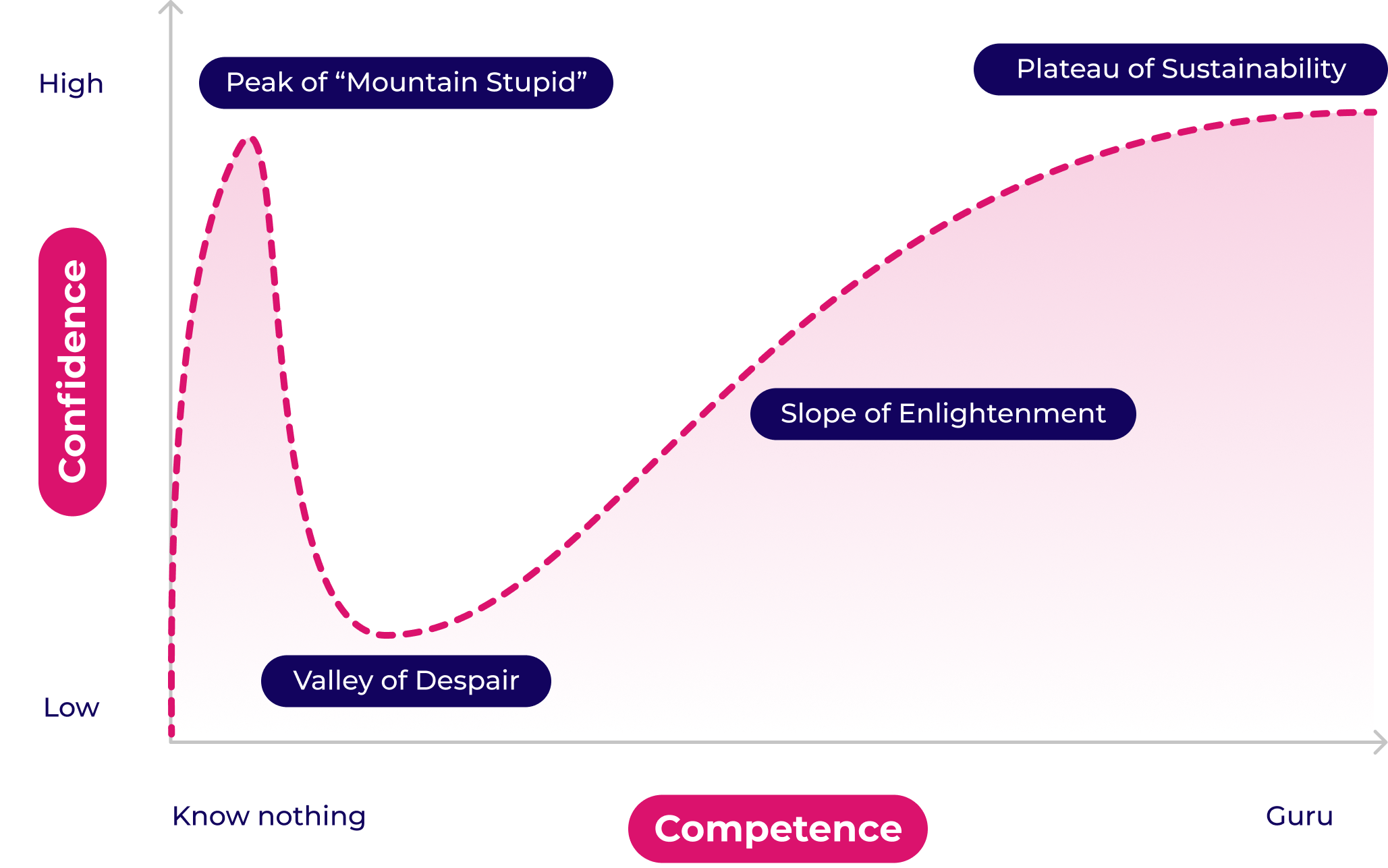
In the late 1990s, two psychologists at Cornell, David Dunning and Justin Kruger, ran a series of tests on logic, grammar, and humor. The result surprised them enough to write a paper about it. The people who scored lowest on the tests were the most confident in their answers. The best performers, meanwhile, tended to underestimate how well they’d done. Put plainly, when you don’t know enough about a topic to see how much you don’t know, you tend to assume you’re fine.
The curve looks roughly like the chart below. Confidence spikes early, after a few articles and maybe a conference talk. Then reality hits, and confidence collapses. As you actually learn the domain, confidence climbs back up (more slowly this time) toward something that matches your real competence.
This matters specifically for a Head of Digital because the dangerous blind spots aren’t the areas where you know you’re weak. You’ll ask for help there. The real danger is the areas where you think you’re at foundation level, and you’re actually still at base. You make calls with quiet confidence; nobody in the building challenges you, because from the outside, you sound credible, and that’s where audience and revenue quietly get lost.
A couple of practical habits help with this. First, when someone with significantly more experience in an area pushes back on your interpretation of something, resist the instinct to defend and instead ask them to show you what you’re missing. Second, for every skill on the list, ask yourself a direct question: if I had to train somebody up to foundation level in this, could I actually do it well? If the answer isn’t a confident yes, you’re not at expert level.
Courses help, but not as much as the marketing for them suggests. The fastest way I’ve seen people genuinely build their horizontal is through exposure. Sit with the analytics team for a few weeks if you have one in-house, rather than simply pull reports, and be in the room for the questions. Run a paid campaign yourself, end-to-end, once, before you start delegating them. Review your own app’s onboarding flow with fresh eyes and no one else in the room. Take one idea all the way through an experiment, from hypothesis to reading the results. That kind of exposure teaches things no article ever will.
Know your blind spots
Nobody I’ve ever met covers all fourteen skills genuinely well. That’s fine, as long as you know it.
What we see again and again when we run a Digital Health Check for stations is the same pattern. A podcast that’s effectively invisible on Spotify because nobody on the team has seriously looked at PVO. An ad server running at a 50% render rate because the configuration was never properly reviewed. Social reach demands lots of effort, generating a real audience and almost no revenue, because the monetization layer was never built around what people were actually doing on those platforms. A sales house quietly selling what’s easy instead of what’s valuable, because there’s nobody internally driving them. An app that is simply a catalog of content and onboarding that hasn’t been properly thought through.
These aren’t really content problems; there are problems of horizontal awareness, of not having somebody in the building who can look at the whole system and see what’s broken.
If you’re not sure where your blind spots are, that’s exactly what a Health Check is for. In less than two weeks, across your full digital ecosystem, we identify where you’re losing audience and revenue, and what to do about it.
Oh….and we guarantee you 10x your investment in additional revenue.