

For a growing share of listeners, the app is the station. It’s where the wake-up alarm lives, where the drive-time show gets pulled up at a red light. It’s where someone finds you again once they’re out of reach of your transmitter. If the app fails them, it doesn’t matter how good the on-air product is upstream: they simply won’t listen.
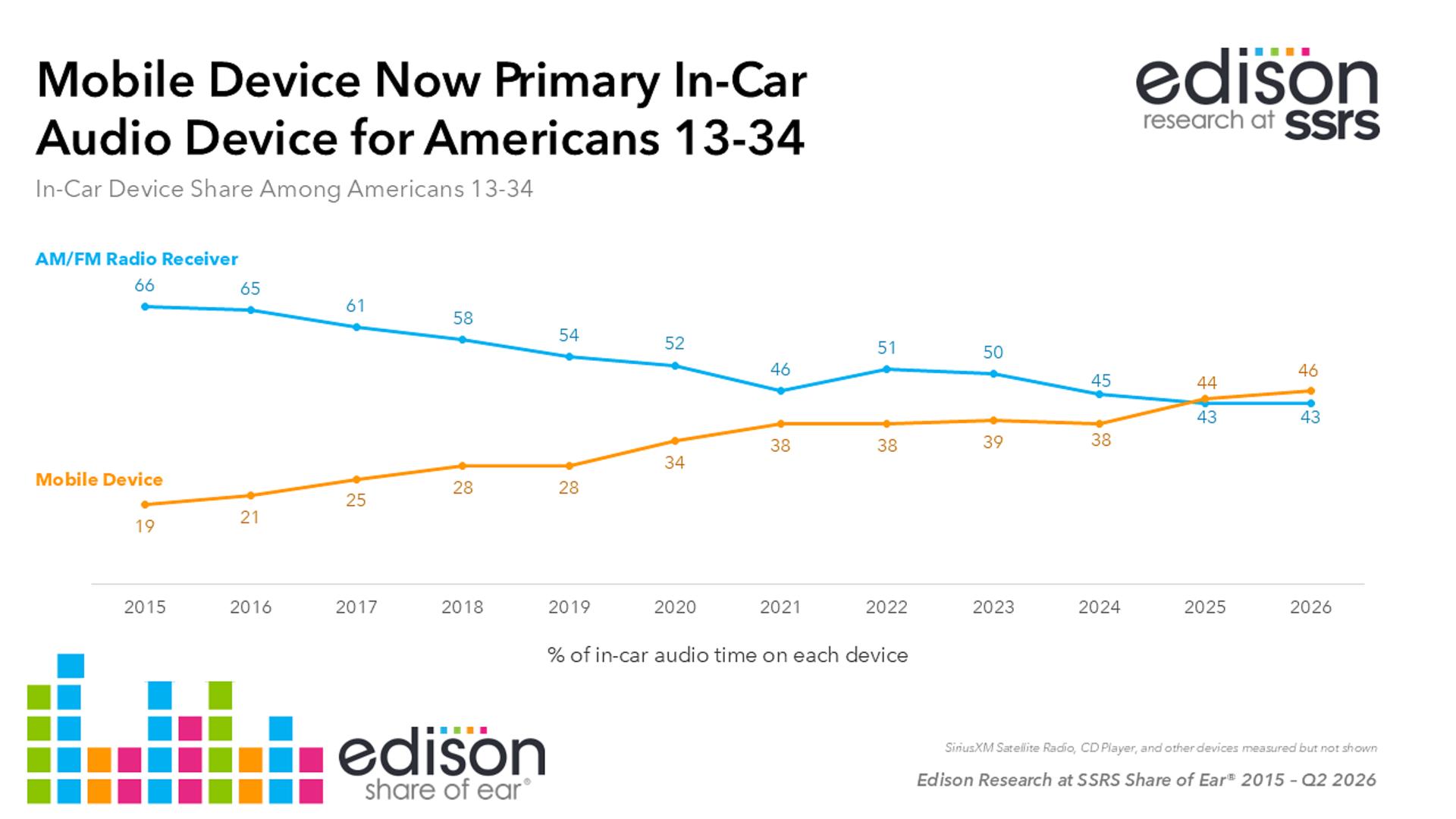
This isn’t a hunch. Edison Research’s Share of Ear study has tracked in-car listening since 2015, and the lines crossed in 2025: among Americans 13-34, mobile overtook AM/FM as the primary in-car audio source. AM/FM slid from 66% to 43%; mobile more than doubled, from 19% to 46%. Eleven years, one direction. A generation that builds its listening habit around a screen and an app won’t migrate back to a dial. The dial itself may disappear from cars altogether at some point – it’s a separate debate – but the habit shift has already happened.
But before an app can deliver your content, it has to be found. This is where most radio stations lose people without ever knowing it. You can have the best morning show in the market and an app built with real care, and still be invisible to someone scrolling the App Store or Google Play, actively looking for exactly what you offer. One of my favorite lines applies perfectly here: to be heard, you first need to be seen. Visibility in the app store is the first step in the entire listening journey, and it’s where most stations get it wrong.
Here’s something most radio app teams don’t realize: you already have the hardest part of app store optimization solved. You just don’t know it, and you’re probably throwing it away with a bad title.
In 2026, both the App Store and Google Play changed how they rank apps. Retention, session frequency, and redownload rate now weigh as much as your title, subtitle, and keywords combined. In plain terms: the algorithms care less about what you say about your app and more about what people actually do with it once they have it.
That’s bad news for most app categories. A shopping app, a game, a utility app: none of them get people to come back regularly on their own. They have to manufacture it with streaks, push notifications, loyalty points, loot boxes. Whole product teams exist just to invent reasons for someone to reopen the app tomorrow.
Radio doesn’t have that problem.
The habit already exists
Someone doesn’t open your app because a notification nagged them into it. They open it because it’s 7:40 am and they want the morning show, or because the drive home isn’t the drive home without your afternoon host, or because the alarm they set runs on one of your station’s streams. The habit was built by decades of broadcast, not by a product manager.
Which means radio already has an unfair advantage on exactly the signals the 2026 algorithms are hunting for: people coming back on day 1, day 7, day 30; long sessions; reinstalling the app on a new phone or after an update. That’s the unfair advantage.
Visibility is the bottleneck
None of this matters if nobody finds your app in the first place. The behavioral factors above are what the industry calls off-metadata signals: they come from how people actually use the app, not from what your store listing says about it. And that’s exactly the problem.
Off-metadata signals only apply to people who already installed. Store discoverability is the gate everything above passes through, the top of the funnel in marketing speak. A station’s retention curve can be absolutely amazing and still go to waste, because there’s no population left to apply it to if nobody ever finds the listing. This is where most station apps quietly sabotage themselves.
The usual offender is the title: “Radio XYZ” or “XYZ FM” and nothing else, no genre, no format, no listening intent. Someone searching “jazz radio” or “region radio” never sees you, because you never told the algorithm you were either of those things.
It often starts with the keyword field: on iOS, title, subtitle, and the 100-character keyword field are indexed as one pool, and station marketing teams routinely repeat the brand name or genre across all three. That’s the same as leaving the space blank. Either way, the result is identical: the algorithm barely shows your app to anyone.
Why fixing this pays more for radio than for anyone else
Fix the metadata on a low-retention utility app, and you get more installs. That’s it: a one-time bump.
Fix the metadata on a radio app, and something different happens:
More qualified installs land on a product that already retains well. The algorithm reads that new traffic as high-quality, not just high-volume. That pushes organic ranking up, which brings more impressions at the same cost. As the installed base grows, redownloads climb with it on a slower cycle, reinforcing the same signal months later.
One fix, compounding returns. That’s not true of most app categories. It’s true of radio because the retention was already there, waiting for enough people to reach it.
Rewriting 30 characters of title, 30 of subtitle, and 100 of keywords is cheap. For most apps, cheap work gets a cheap result. For a radio app, cheap work gets a disproportionate one, because you’re not building the retention half of the algorithm from scratch. You’re just finally letting people find what already works.
Three ways this breaks anyway
That said, the advantage isn’t unconditional. Three things can kill it even after the metadata is fixed.
Weak onboarding. If someone opens the app and they can’t access audio content within a few seconds (thanks to video ads popping up, account creation walls, geolocation prompts, permission requests before they’ve heard a single note), they leave before the habit ever gets a chance to form. Structural advantage or not, you still have to get out of your own way in the first ten seconds.
Technical instability. An app that crashes doesn’t read as “sticky” to the algorithm. It reads as unreliable. Google tracks two things closely here: crash rate, and something called ANR (short for “Application Not Responding,”) which is what happens when the app freezes or hangs instead of crashing outright, usually for a few seconds that feel much longer to the listener. Google’s rough tolerance is 0.5% for ANR and 1% for crashes, and audio apps tend to blow past both at the background-to-foreground transition: the moment someone switches to another app mid-stream and comes back to find the player stuck.
Category crowding. If every station in your market makes the same brand-only-title mistake, nobody’s penalized relative to the others: you’re all equally invisible together. The size of this opportunity depends entirely on how under-optimized your local competitive set currently is. Audit your competitors’ listings before you promise a client a quick win. In some markets, this is a first-mover advantage. In others, everyone already moved.
What this means in practice
If you’re running or advising on a radio app, here’s the sequence that actually works.
Fix the metadata first: title, subtitle, keyword field, screenshot captions. It’s the cheapest layer and the one everything else depends on, so nothing compounds until it’s done. Check technical health at the same time, since there’s no point driving installs into an app that freezes every time someone switches away and back. Then widen the on-ramp with custom product pages and localization, so different genres, geographies, and audiences each find their own way in, even though they’re all feeding the same underlying advantage.
Be honest about the timeline too. The metadata fix shows up fast, in conversion rate. The real payoff, the compounding effect where ranking climbs because the algorithm starts trusting your traffic, takes longer. That shows up over the D7 to D30 retention window, not overnight.
Radio spent decades building the one thing every other app category has to fake. The only question left is whether your app store listing is letting anyone find it.
 Français
  English