
RTL Germany announced 600 job cuts last week. Most headlines focused on the cost-cutting. A few mentioned streaming. But the most important part of the announcement was a single sentence that almost no one highlighted:
Here it is:
“Today, individual channel teams are responsible for content on a specific TV channel. We want to merge these teams so they produce the best possible content together – independent of the channel, with a focus on RTL+.” (Frankfurter Allgemeine Zeitung)
This is more than an operational adjustment. It is RTL acknowledging that the channel-centric model – the foundation of broadcasting for decades – no longer reflects how audiences consume content.
And if you work in radio, you should pay attention.
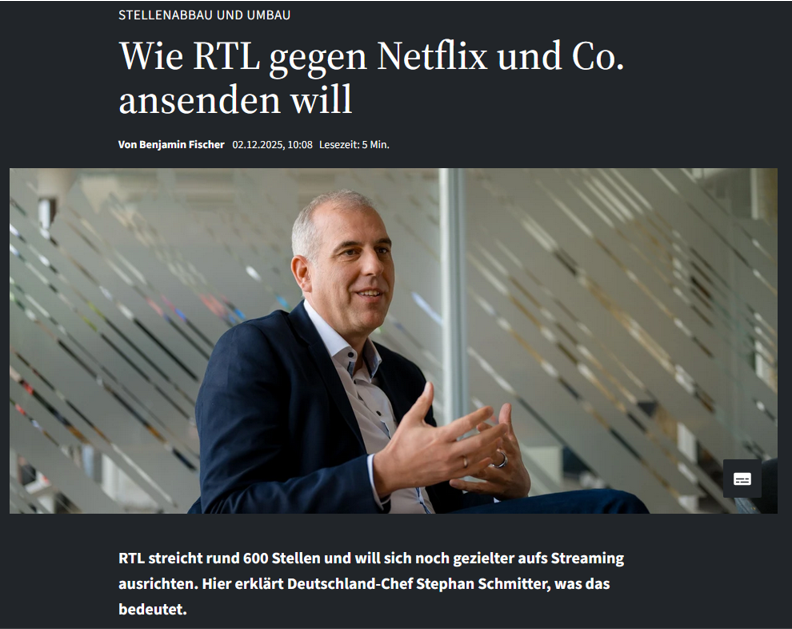
The channel is dead. Long live the content.
For decades, broadcasters have organised everything around linear schedules. Each channel had its own team, its own identity, its own targets. Teams competed internally for resources and budget. The question was always: “What should we put on Channel 2 at 8pm?”
This made perfect sense when distribution was scarce. When you controlled the pipe, you controlled what people watched. The channel was the product.
But that world is gone. Today, viewing is increasingly happening through platforms where viewers select content directly, where algorithms surface recommendations, and where the original broadcast channel means almost nothing. Netflix doesn’t have channels. Disney+ doesn’t have channels. YouTube doesn’t have channels in the traditional TV sense.
RTL’s restructuring recognises this reality: content now competes directly, regardless of where it first aired or which “channel” produced it. The question is shifting from “What do we put on Channel X?” to “What content will our audience actually want, and where will it perform best?”
It’s a fundamental shift from distribution-led to content-led.
This was inevitable
Audience behaviour started shifting years ago. Younger viewers don’t think in channels. Many don’t even know what channel a show airs on. They follow creators and formats and specific topics, discovering content through recommendations rather than schedules. The platform guides their choices, not the programming grid.
This is the same pattern we are seeing in audio. The linear grid still exists, radio stations still broadcast on FM frequencies, but growth is elsewhere. Consumption is increasingly unbundled, personalised, and platform-driven.
RTL’s announcement is just another confirmation that the centre of gravity has shifted.
What changes in practice
Moving from a channel structure to a platform strategy isn’t just about reorganising the org chart. It requires fundamentally different ways of working.
A platform strategy means producing content that can travel. That documentary you’re commissioning? It needs to work as a 45-minute episode, a 1-minute social clip, and a 5-episode series, depending on where audiences find it.
Your morning show team can’t just think about what works at 7 am anymore. They need to consider how content will perform on TikTok at lunch, how segments might work as podcasts for the evening commute, and whether the content has any value at all three days later when someone discovers it through search.
The org chart changes, too. When teams were organised around channels, the lines of authority were clear. When you’re organised around content that needs to perform across multiple surfaces, suddenly everyone needs to collaborate with everyone else. The political nightmare of “whose budget pays for this?” and “who gets credit?” becomes constant.
Most large broadcasters I’ve worked with understand this. Actually implementing it is where things get messy.
Radio is following the same path
Radio is behind TV in this cycle, but the trajectory is the same.
Most radio organisations are still structured around the grid: morning show, midday show, etc. Each slot has its team, its personality, its specific remit.
But as more listening moves to on-demand and platform, the grid becomes less central. The same questions emerge:
How should you organise your teams? Do you build for the slot, or for the audience? How do you produce content that works across FM, streaming apps, podcast platforms, and YouTube? What does success even look like when linear and digital have fundamentally different metrics?
RTL’s approach offers a preview of what many broadcasters, including radio, will need to consider. Not next year. Not when streaming ‘really takes off.’ Now, while you still have leverage and resources to experiment.
The structure change matters more than the cuts
Job reductions attract headlines because they’re concrete and affect real people. But they don’t explain the strategic shift. A change in team structure does.
RTL is preparing for a world where channels matter less, the platform matters more, and content travels across multiple surfaces. Where audience loyalty is towards the shows, the creators, and the brands, not towards channels that never really resonated with younger viewers anyway.
The question isn’t whether this shift will happen – it is already happening. Younger audiences moved to on-demand consumption years ago. With the platforms dominating the space, it’s time for the content organisations to finally catch up.
The real question for other broadcasters is how quickly they adapt their organisations to match how audiences actually consume content today.
The writing on the wall
Most traditional broadcasters can see where this is heading. The reports about declining linear audiences and platform growth keep piling up, each one showing the trend accelerating slightly faster than the previous quarter’s forecast.
But knowing something intellectually and acting on it strategically are entirely different things. Change is hard. Restructuring creates friction. Merging teams means difficult conversations about roles, authority, and budgets. It’s easier to keep running the existing playbook while adding digital as a side project.
That approach worked for a while, but it doesn’t anymore.
RTL’s announcement should be read as a signal, not just about one company’s troubles, but about where the entire industry is heading. The broadcasters who recognise this early and restructure accordingly will have a chance to compete in the platform era. Those who wait until linear revenues decrease even further will find themselves restructuring from a position of weakness, not strength.
For radio, the timeline might feel longer. FM still reaches millions. In-car listening still dominates. But as I detailed in my recent analysis of French radio audience decline (article in French), the erosion is accelerating, not slowing. The generational cliff is real.
The time to rethink your team structure, your content development process, and your platform strategy is while things still look relatively stable. Because in digital transformation, the longer you wait, the harder it gets.
RTL just showed you the path forward. The question for radio stations is whether they will take it seriously while they still have the choice.
 Français